


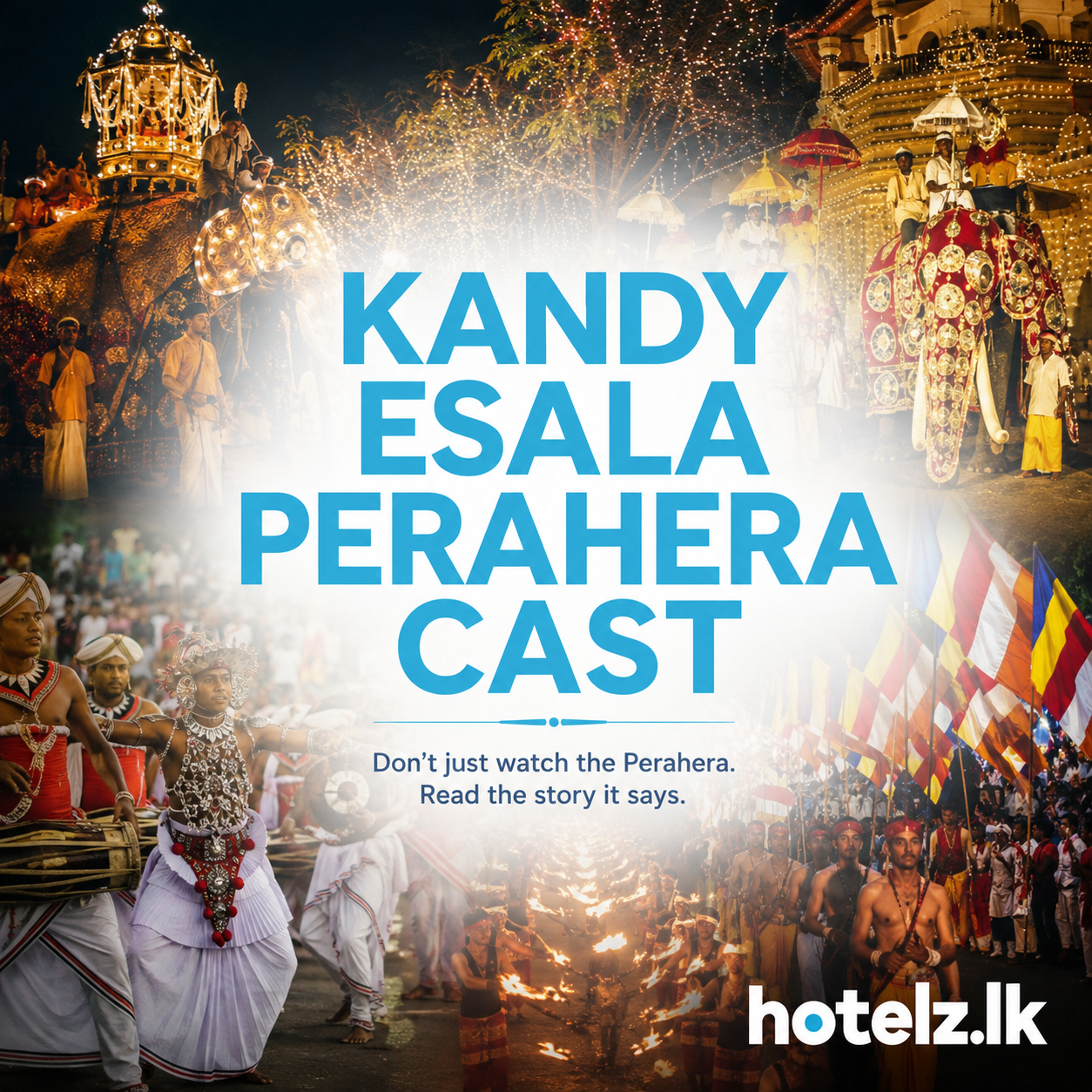
Kandy Esala Perahera Cast: Read the Procession
The Kandy Esala Perahera is made up of around 1,000 people and up to 100 elephants, taking part in five sections: the Maligawa Perahera, representing the Sri Dalada Maligawa, followed by the four Devala Peraheras of Natha, Vishnu, Kataragama and Pattini.
But it is much more than just a colourful parade. Everyone has a role, and the procession follows a carefully arranged order connected to the history and religious traditions of the Sri Dalada Maligawa and the four Devalas. The Esala Perahera brings together the historical traditions, along with dancers, musicians, elephants, temple officials and people whose roles have been passed down through generations.
If you are watching the Perahera as a traveller, there is much more to see than the costumes and elephants.
Who is that man at the front? Why are those flags there? Why does everyone stand when one particular elephant arrives?
Let’s read the procession from beginning to end.
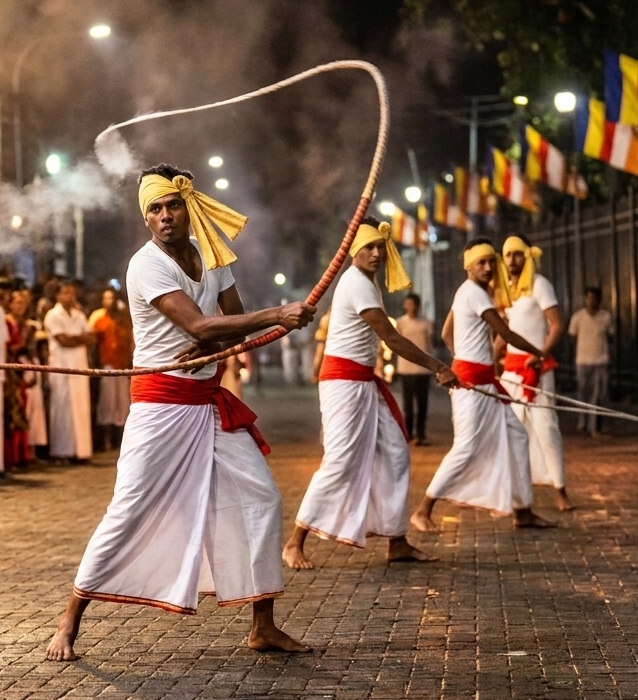
The Whip-Crackers
Walking at the very front of the procession are the Kasakaara, or whip-crackers. They crack long whips as they walk at the front of every perahera along the road.
There is a practical reason for this. The cracking helps clear the road and alert the crowd that something is approaching. The custom also has a much older connection: whip-crackers traditionally announced the approach of kings and high officials in Sri Lanka.
The loud whip cracking sound is the first sign you will get before you see or hear anything else, the Perahera is announcing itself.
Fireball Performers
The whip-crackers are followed by performers who spin balls of fire.
They are not there only to create a dramatic show for spectators. Traditionally, the fire performers help clear and illuminate the route ahead of the procession hinting that the ordinary Kandy street is about to become a ceremonial route.
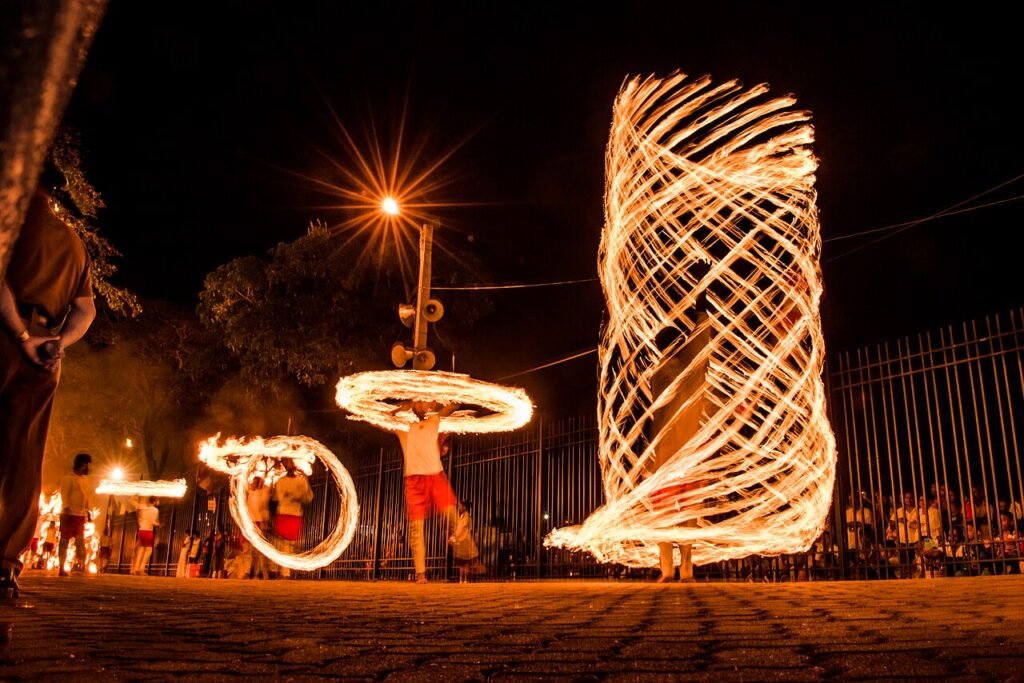
Image Source: Sachin Kaveesha Fernando, CC BY-SA 4.0, via Wikimedia Commons
The Flag-Bearers
Next come the Kodikaara, the flag-bearers. They carry the Buddhist flag, the Sri Lankan national flag, flags of the old provinces of the Sinhalese kingdom as well as flags associated with the Sri Dalada Maligawa. Historical accounts also describe the traditional flags representing districts and important noble houses of the Kandyan kingdom.
This means the flags are doing more than filling the procession with colour. They identify the old political and religious institutions represented in the Perahera.
The Peramune Rala – The Front Official
Next, riding on the first elephant of the Perahera is the Peramune Rala, or Front Official. In the time of the Kandyan kings, he carried the royal authority or mandate allowing the Perahera to take place. He carries the Lekam Mitiya, an ola-leaf manuscript/register concerning Maligawa lands, tenants and their traditional services.
An ola is a traditional Sri Lankan manuscript made from prepared palm leaves. So what may look like a simple bundle or document is actually part of an old system of written authority.
Hewisi Drummers
The Hewisi musicians bring the drums: the geta bera, the traditional Kandyan drum; the davul bera, a larger barrel-shaped drum; and the horanewa, a wind instrument with a strong, penetrating sound.
The Hewisi music provides the rhythm by which the procession moves. The dancers work to its rhythm, and the elephants move at its measured pace. That is why the sound feels so constant throughout the Perahera. It is helping hold a procession of hundreds of people and elephants together.
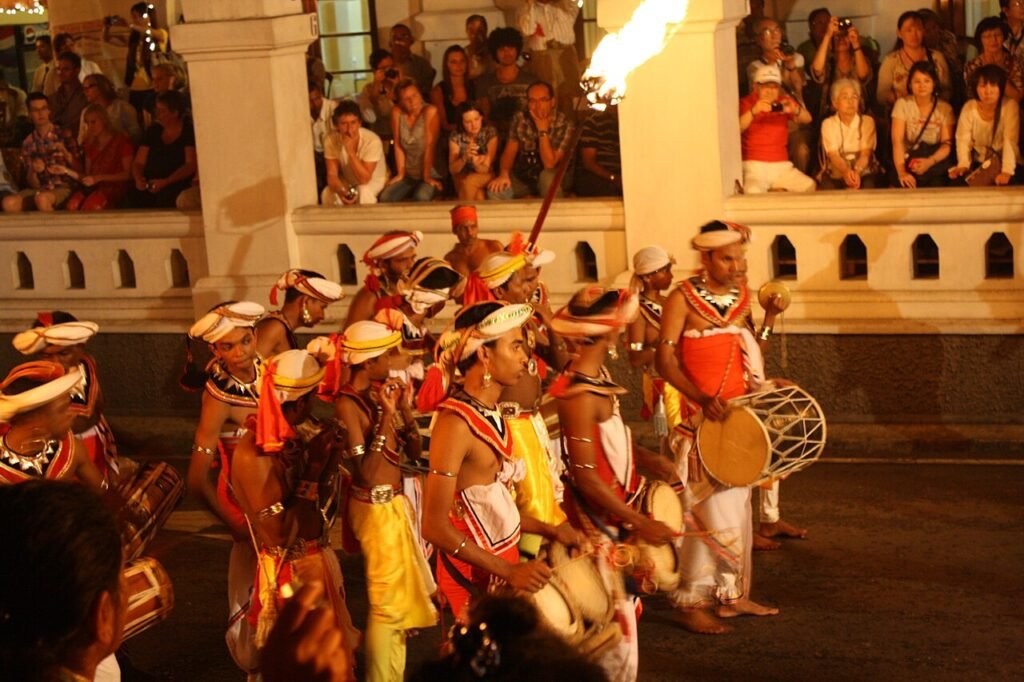
Image Source: Omar AV, CC BY 3.0, via Wikimedia Commons
The Gajanayaka Nilame
After the drummers comes the Gajanayaka Nilame, riding an elephant and carrying a silver goad called an ankusa, symbol of his authority.
The title Gajanayaka Nilame itself goes back to the time of the Sinhala kings, when the Gajanayaka Nilame was a senior royal official responsible for the king’s elephants and their stables.
The Kandyan Dancers
The dancers are one of the easiest parts of the Perahera to recognise, but they are also one of the easiest to misunderstand. There is not one single group of “Kandyan dancers”. Different forms of dance appear in the procession, with different costumes, instruments and movements.
Ves Dancers
The Ves dancers wear the famous silver-coloured ves thattuwa headgear, along with white ceremonial clothing and ornaments. The Ves tradition is the principal form of Kandyan dance and has a particularly formal place in the Perahera.
Naiyandi Dancers
The Naiyandi dancers are easier to distinguish by their red costumes and turbans. Their movements are quicker and more energetic than the formal Ves style.
Udekki Dancers
The name gives you a clue. Udekki dancers carry the udekki, a small hourglass-shaped drum. They play it while dancing, so the musician and dancer are the same performer.
Pantheru Dancers
The Pantheru dancers carry the pantheru, a small tambourine-like instrument. The instrument is played while performing a series of quick movements. The tradition has also been associated historically with martial occasions.
There are also fire-dancers and chamara fan-bearers, adding some of the most dramatic movements and visual effects to the procession.
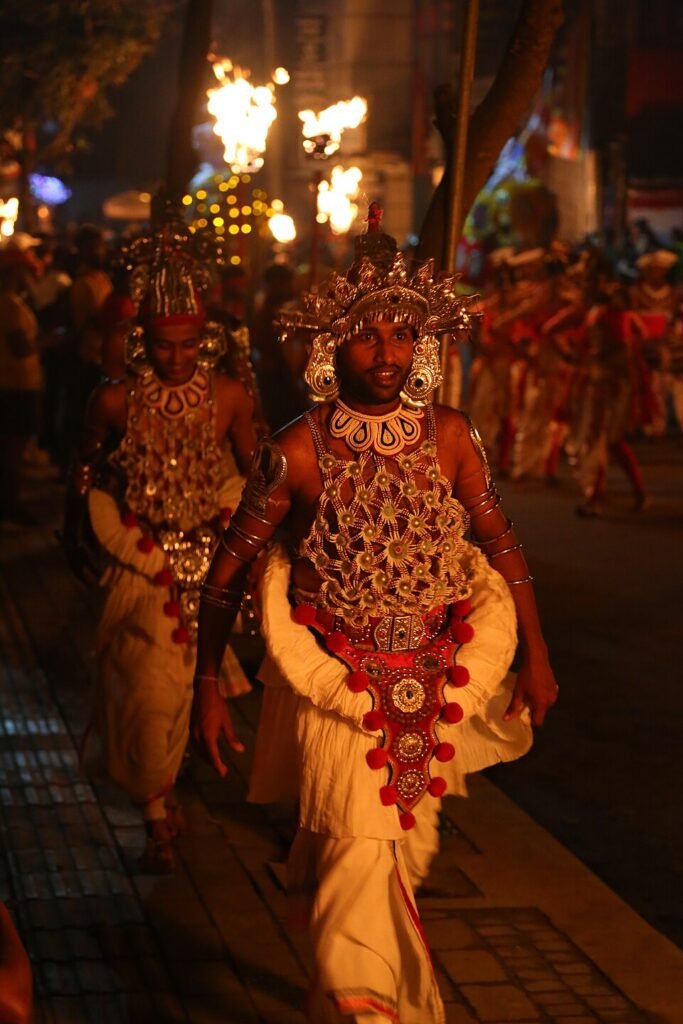
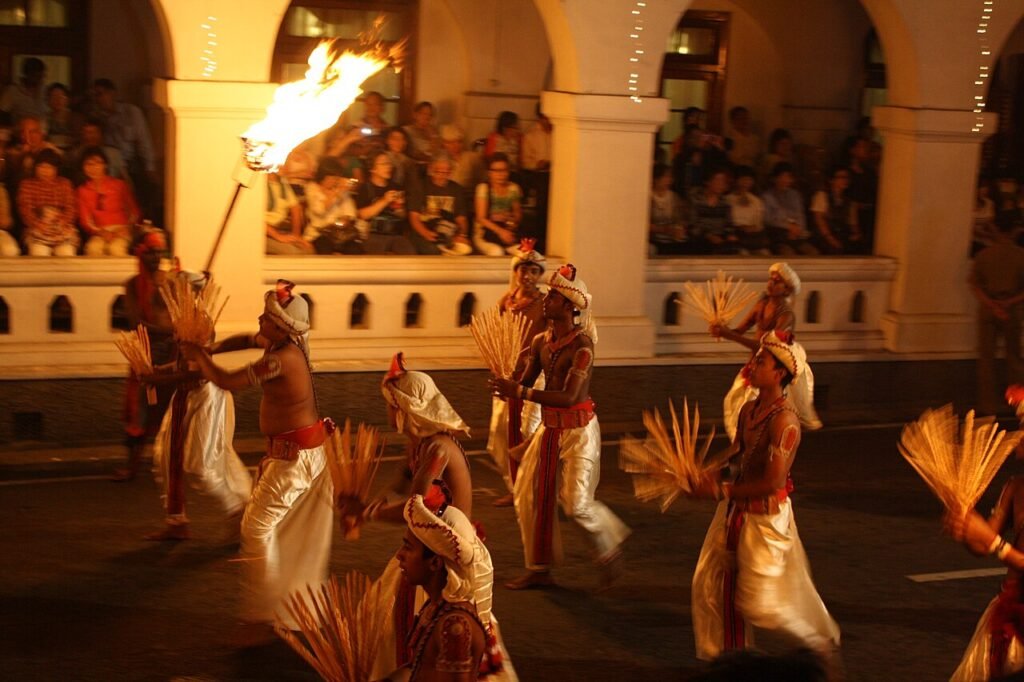
Image Source: Omar AV, CC BY 3.0, via Wikimedia Commons
The Maligawa Tusker
The most important elephant is the Maligawa Tusker, which carries the Karanduva, the ceremonial casket representing the Sacred Tooth Relic. The actual Sacred Tooth Relic does not travel through the streets during the Perahera. The casket symbolically represents it during the procession.
The Maligawa Tusker is not ridden by a mahout on its back. No one rides on the lead tusker, as a mark of respect for the Sacred Tooth Relic. The tusker walks on a narrow white cloth known as the pavada, which is laid down before it. Two elephants accompany it on either side, with attendants who scatter flowers towards the casket. As the Maligawa Tusker approaches, everyone stands from their seats and raise their hands in worship to show their respect.
The elephant carrying it is carefully selected. According to the Temple of the Tooth, the tusker must meet particular requirements, including having the right temperament for the difficult task of walking for hours through a crowded city surrounded by noise, lights and thousands of people.
So being the Maligawa Tusker is not simply a matter of being the biggest elephant. It must also be calm enough to carry one of the most important objects in the entire ceremony.
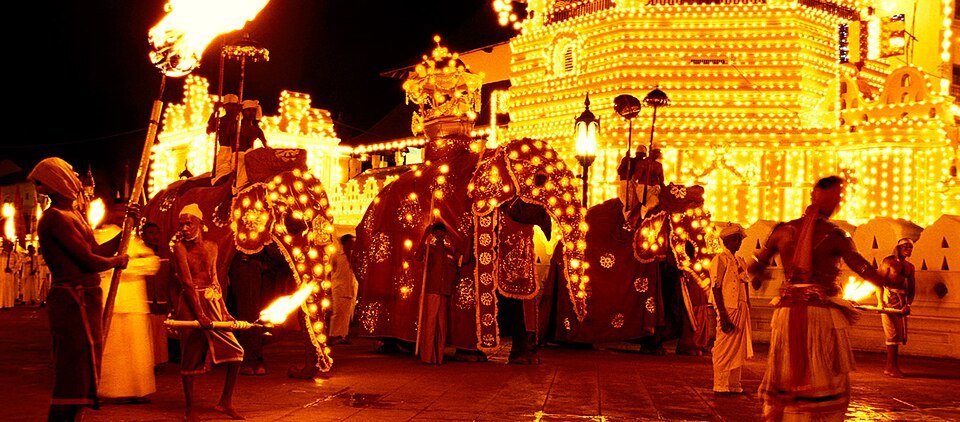
Image Source: Ashan96, CC BY-SA 4.0, via Wikimedia Commons
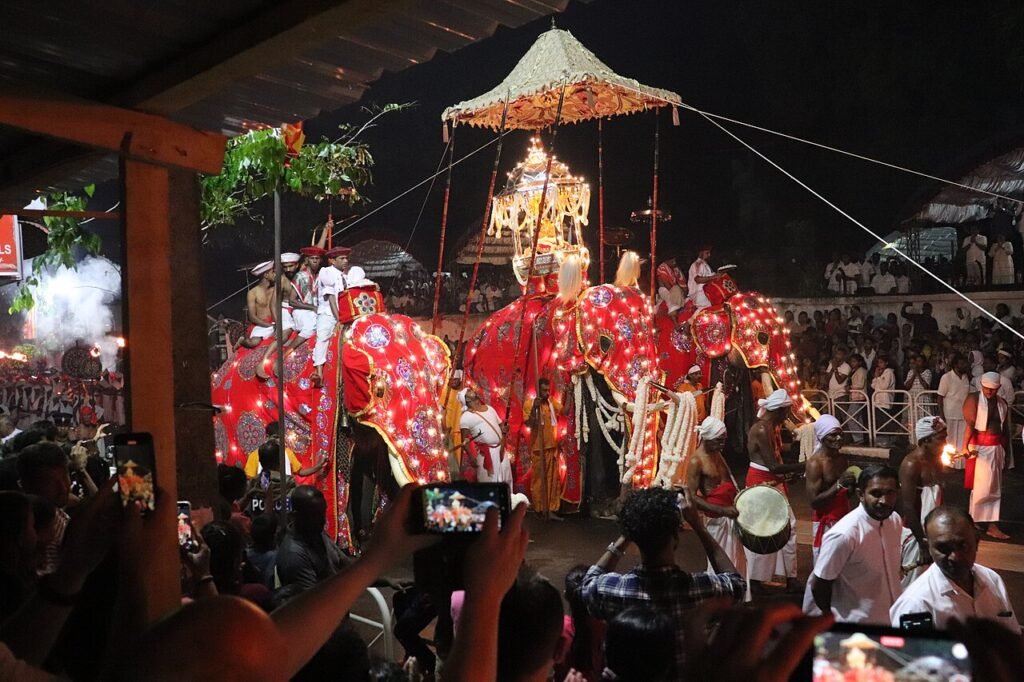
Image Source: Phsmet, CC BY-SA 4.0 https://creativecommons.org/licenses/by-sa/4.0, via Wikimedia Commons
The Kavikara Maduwa
After the three elephants surrounding the sacred casket comes the Kavikara Maduwa, the traditional singers of the Perahera. They sing in praise of the Sacred Tooth Relic as they travel with the procession.
The Maligawa Dancers and Drummers
The Maligawa Tusker is followed by more dancers and drummers, Viharagam dancers and drummers.
These performers traditionally come from villages and lands that were historically granted to the Maligawa by former kings. Their families were connected to specific services for the temple, and performing in the Perahera was part of that traditional duty.
The dancers and drummers who appear here are therefore not simply hired performers brought in for the festival. Their participation is connected to an older system of temple service and royal land grants.
The Diyawadana Nilame
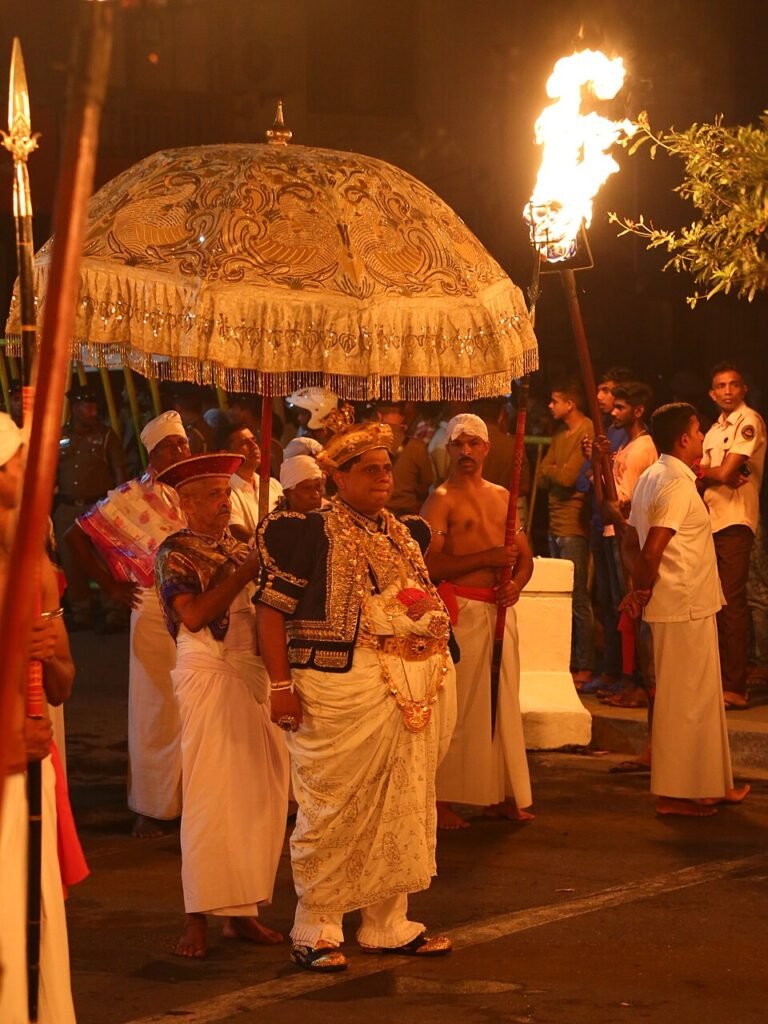
At the end of the Maligawa section comes the Diyawadana Nilame, the chief lay custodian associated with the Sri Dalada Maligawa. He wears elaborate Kandyan ceremonial dress and carries a sword and other traditional items of office.
The Diyawadana Nilame is responsible for important aspects of the Maligawa’s administration and plays a central role in organising the Perahera. His position also marks the end of the Maligawa section.
But the Perahera is not over. Four more processions are still to come.
The Four Devalas
The Maligawa Perahera is followed by four more processions: Natha Devala, Vishnu Devala, Kataragama Devala and Pattini Devala. These four shrines are traditionally associated with guardian deities of Sri Lanka. Each has its own procession led by its own Basnayake Nilame, with its own deity, colours, music, costumes, performers and ceremonial traditions..
The four Devala processions follow broadly the same pattern of the Maligawa Procession. The only difference is they do not have the whip-crackers, Peramune Rala or Gajanayaka Nilame found at the front of the Maligawa procession.
Natha Devala
The first Devala procession comes from Natha Devala. Green is the dominant colour of this procession. Natha is traditionally regarded as the future Buddha, or Bodhisattva, and is also considered the tutelary deity of Kandy. The Kandyan kings traditionally had an important connection with Natha Devala. Kandyan kings were traditionally crowned at this shrine.
At the front is the Devale elephant, dressed in green and carrying the insignia of Natha, followed by dancers, drummers and the Basnayake Nilame of Natha Devale, together with the Nilames of its affiliated shrines. Then come more elephants in brightly coloured coverings, their brass bells sounding as they move through the streets.
Vishnu Devala
The next procession comes from Vishnu Devala and this time blue dominates the scene. Vishnu is regarded in Sri Lankan Buddhist tradition as a protector of Buddhism and Sri Lanka. The blue flags, banners, lights and elephant coverings make this procession easy to distinguish from the green of Natha.
The Devale elephant carries the insignia of Vishnu, while the Basnayake Nilame of Vishnu Devale follows with the Nilames of other Vishnu shrines in the region. More than a hundred dancers traditionally take part, followed by performers including jugglers and acrobats.
Kataragama Devala
This procession is associated with Skanda, the Hindu god of war and victory. Here the dominant colour is red. The Devale elephant dressed in red carries the trident, the symbol of Skanda.
Karnatic-style music and Kavadi dancers are the most distinguished characters of this procession, whose tradition has strong South Indian connections. The other elephants are also dressed in red, and there are more elephants in this procession than in the preceding Devala processions, a reflection of the importance traditionally given to Skanda.
Pattini Devale
The final Devala procession is that of the Pattini Devale, associated with Pattini, the goddess traditionally connected with purity, protection and healing. White dominates this section.
The elephants are covered in white, while the Basnayake Nilame travels beneath a white ceremonial umbrella. But there is something here you will not see in the other three Devala processions: Women dancers. Women taking part in the Perahera is a relatively recent development. Their performances include dancing with Kala Gedi, traditional clay pots, and winnows.
And on the last five nights, there is one more thing to watch for.
The Randoli
At the very rear of the Randoli Perahera come the Randoli, the traditional palanquins carried in honour of the consorts of the four deities. There is also a royal connection to their history: another tradition holds that similar palanquins were used by the queens of the reigning Kandyan monarch.
Today, devotees place offerings, including coins, into the palanquins as they pass.The Randoli are only seen in this form during the Randoli Perahera, which begins on the sixth night.
Now You Know What You Are Watching
Once you know the order, the Perahera stops looking like one enormous parade. You begin to see who is who, what they are carrying, which institution they represent, and why they are there. And that is when watching the Kandy Esala Perahera becomes much more interesting.
Next time you’re watching the Esala Perahera, Don’t just watch the Perahera. Read the story it says.

.jpg)
