

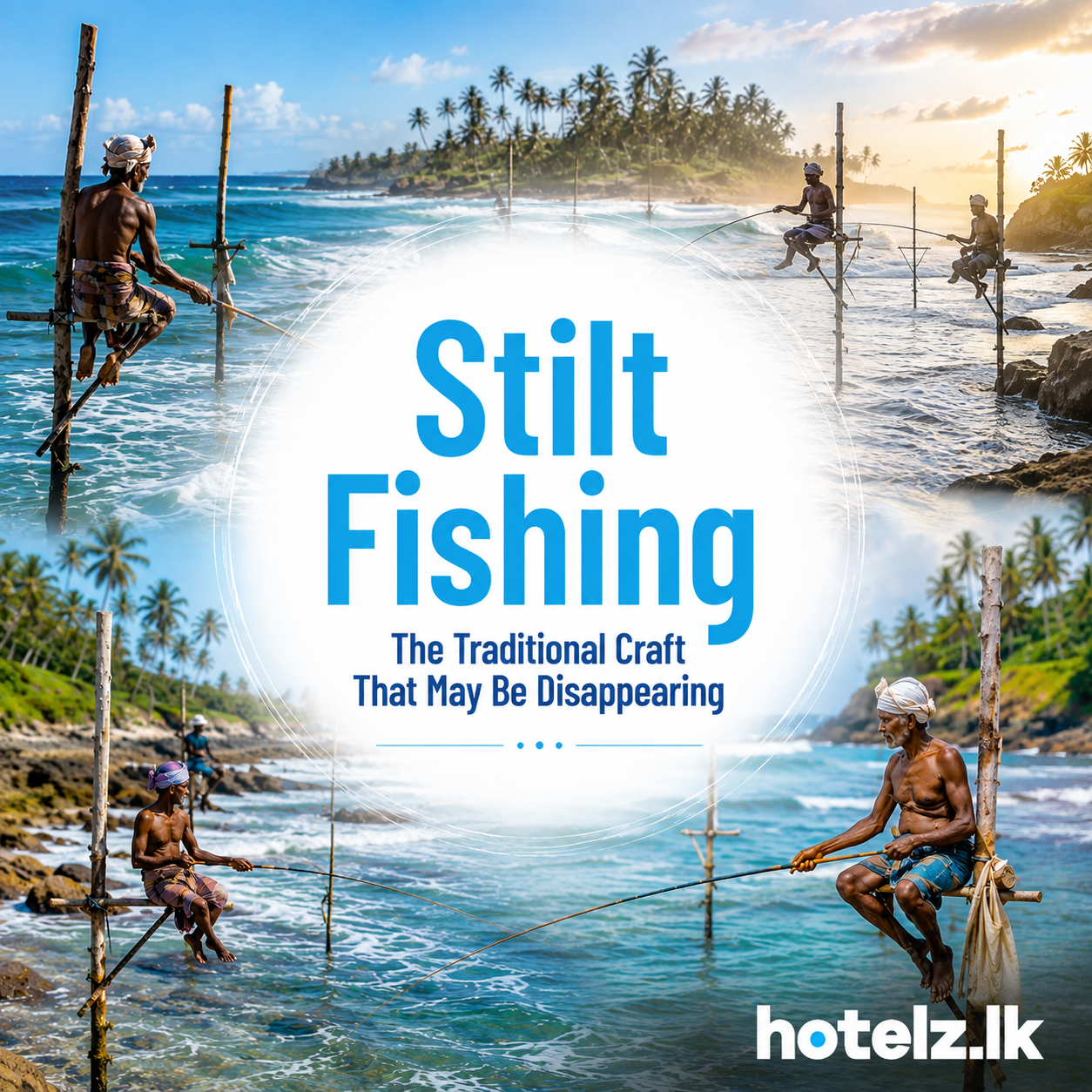
Stilt Fishing in Sri Lanka: The Traditional Craft That May Be Disappearing
If you have travelled along Sri Lanka’s southern coast, you may have seen fishermen sitting on a wooden pole in the sea, holding a simple fishing rod, something that looks almost too unusual to be real.
This is stilt fishing, locally known as ritipanna. It is a unique traditional fishing method strongly associated with Sri Lanka’s southern coast, particularly the area around Koggala, Kathaluwa, Ahangama, Midigama and Weligama in what is now the Galle-Matara coastal belt.
But how did people start fishing like this?

Origin of Stilt Fishing
Sri Lankan stilt fishing is not actually an ancient fishing method, despite how often it is described that way online. The best-supported historical accounts place its development around World War II, roughly the 1940s.
During the war, food shortages and pressure on existing fishing grounds made catching fish more difficult. This pushed local fishermen experiment with ways of fishing from the shallow water without needing a boat.
Over time, this simple idea evolved into what is now known as stilt fishing or ritipanna. The technique became established along the southern coast and developed into a specialised fishing tradition passed through generations.
How Does Stilt Fishing Work?
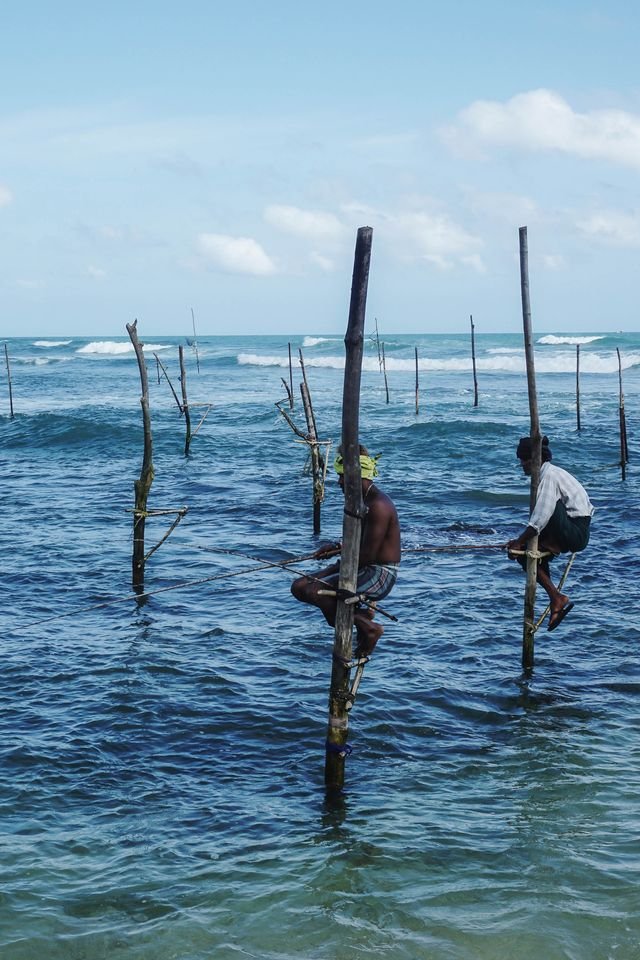
The setup is quite simple.A long wooden pole is fixed into the shallow seabed, with a small crossbar called the petta attached to it. The fisherman sits or stands on this crossbar and fishes with a rod and line.
This position gave them access to the water beyond the immediate breaking waves while keeping their shadow and movement relatively limited, allowing them to fish for small coastal species.
However, stilt itself is not the entire technique. It requires an intimate understanding of the sea, tides, waves, currents, weather and fish movement. Research on the communities describes this local knowledge as an important part of the fishing system.
How did it become a tradition?
What began as a practical solution eventually became a family occupation.
Knowledge of where to place the stilts, when to fish, how to read the water and how to make the equipment was passed between generations. Fishing communities also developed their own traditional fishing territories, known as rendapola, with community systems for managing access to these areas.
The Decline of Stilt Fishing
The 2004 Indian Ocean tsunami severely affected the southern coast and disrupted traditional fishing grounds. Fishermen reported changes in the coastal environment and declining catches, while many of the original stilts were destroyed.
After that, stilt fishing gradually became less practical as a livelihood. Modern boats and other fishing methods were more productive, while the spectacular image of a fisherman sitting above the waves became increasingly valuable to Sri Lanka’s tourism industry.
From Livelihood to Tourist Attraction
What began as an ingenious wartime fishing solution has now become one of the most recognisable images of Sri Lankan coastal culture over time. This is a good example of how traditions change.
While some of these fishermen still genuinely fish, some fishermen has made earning money from tourists who want photographs their source of income. At certain locations, stilt fishing has therefore shifted from a fishing activity to a tourism performance.
But that’s not necessarily a scam. It’s adapting. When a traditional livelihood stops providing enough income, people adapt.
If tourists are willing to pay for the image of a stilt fisherman, and fishing no longer pays enough, the fisherman has a very practical reason to take the photograph.
The problem is not that the fishermen changed. The problem is that the original livelihood is becoming difficult to maintain.
A Tradition on the Edge
Today, only a small number of fishermen continue genuine stilt fishing as a traditional livelihood. As modern fishing methods have become more practical and tourism has changed the role of the stilts, the practice has slowly declined.
But the fishermen who continue the tradition should not be overlooked. Their knowledge of the sea and the skills passed down through generations are what give stilt fishing its cultural value.
A tradition does not have to be thousands of years old to be worth protecting. The stilts may be the symbol, but the fishermen are the heritage.